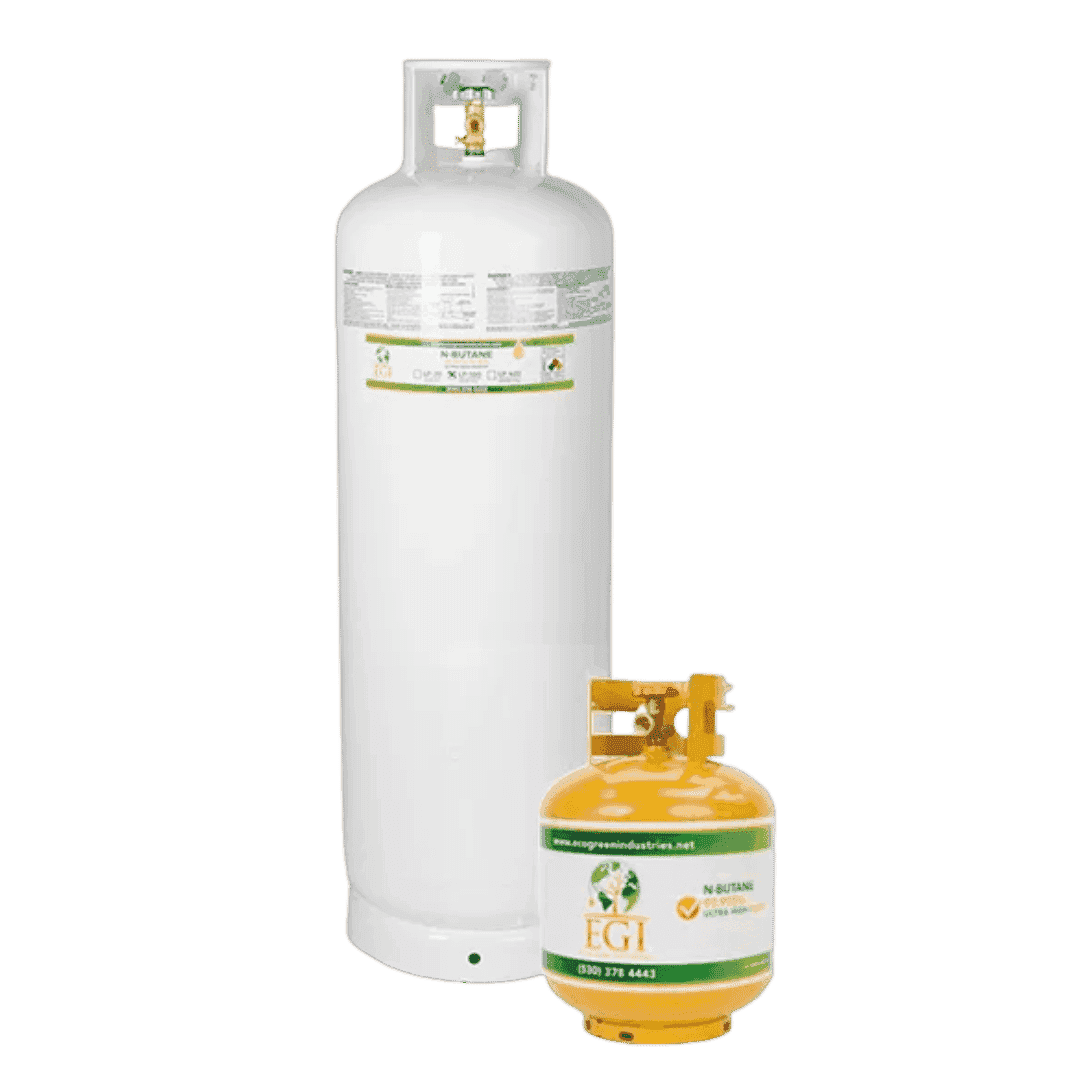
One of the most popular solvents used in earlier concentrate extraction methods. Butane is marginally cheaper than propane and can be used to produce a wide range of concentrate products.
Butane (/ˈbjuːteɪn/) is an alkane with the formula C4H10. Butane exists as two isomers, n-butane with connectivity CH3CH2CH2CH3 and iso-butane with the formula(CH3)3CH. Both isomers are highly flammable, colorless, easily liquefied gases that quickly vaporize at room temperature and pressure. Butanes are a trace components of natural gases (NG). The other hydrocarbons in NG include propane, ethane, and especially methane, which are more abundant. Liquefied petroleum gas is a mixture of propane and some butanes.
| |||
| |||
| Names | |||
|---|---|---|---|
| Preferred IUPAC name Butane | |||
| Systematic IUPAC name Tetracarbane (never recommended) | |||
Other names
| |||
| Identifiers | |||
3D model (JSmol) | |||
| 969129 | |||
| ChEBI | |||
| ChEMBL | |||
| ChemSpider | |||
| ECHA InfoCard | 100.003.136 | ||
| EC Number |
| ||
| E number | E943a (glazing agents, ...) | ||
| 1148 | |||
| KEGG | |||
| MeSH | butane | ||
PubChem CID | |||
| RTECS number |
| ||
| UNII | |||
| UN number | 1011 | ||
CompTox Dashboard (EPA) | |||
| |||
| |||
| Properties | |||
| C4H10 | |||
| Molar mass | 58.124 g·mol−1 | ||
| Appearance | Colorless gas | ||
| Odor | Gasoline-like or natural gas-like | ||
| Density | 2.48 kg/m3 (at 15 °C (59 °F)) | ||
| Melting point | −140 to −134 °C; −220 to −209 °F; 133 to 139 K | ||
| Boiling point | −1 to 1 °C; 30 to 34 °F; 272 to 274 K | ||
| 61 mg/L (at 20 °C (68 °F)) | |||
| log P | 2.745 | ||
| Vapor pressure | ~170 kPa at 283 K | ||
Henry's law constant (kH) | 11 nmol Pa−1 kg−1 | ||
| −57.4·10−6 cm3/mol | |||
| Thermochemistry | |||
Heat capacity (C) | 98.49 J/(K·mol) | ||
Std enthalpy of formation (ΔfH⦵298) | −126.3–−124.9 kJ/mol | ||
Std enthalpy of combustion (ΔcH⦵298) | −2.8781–−2.8769 MJ/mol | ||
| Hazards | |||
| GHS labelling: | |||
 | |||
| Danger | |||
| H220 | |||
| P210 | |||
| NFPA 704 (fire diamond) | |||
| Flash point | −60 °C (−76 °F; 213 K) | ||
| 405 °C (761 °F; 678 K) | |||
| Explosive limits | 1.8–8.4% | ||
| NIOSH (US health exposure limits): | |||
PEL (Permissible) | none | ||
REL (Recommended) | TWA 800 ppm (1900 mg/m3) | ||
IDLH (Immediate danger) | 1600 ppm | ||
| Related compounds | |||
Related alkanes | |||
Related compounds | Perfluorobutane | ||
| Supplementary data page | |||
| Butane (data page) | |||
Except where otherwise noted, data are given for materials in their standard state (at 25 °C [77 °F], 100 kPa). | |||


The name butane comes from the root but- (from butyric acid, named after the Greek word for butter) and the suffix -ane (for organic compounds).
English
Etymology
IUPAC nomenclature, from but- (“four carbon prefix”) + -ane (“alkane suffix”), the former is derived from the same stem as the foul-smelling carboxylic acid liberated in rancid butter, "butyric acid", hence cognate with butter.
Pronunciation
- IPA(key): /ˈbjuːteɪn/
- Rhymes: -uːteɪn
Noun
butane (countable and uncountable, plural butanes)
- (organic chemistry) A hydrocarbon (either of the two isomers of C4H10, n-butane