
Embed Code

Social Share

**Apollo 11**

In the cannabis lexicon, Apollo 11 is a celebrated sativa-dominant hybrid strain that draws inspiration from the iconic lunar mission of the same name. This strain is renowned for its ability to launch users into a state of heightened awareness and creativity, akin to the pioneering spirit of the astronauts who first set foot on the moon. The lineage of Apollo 11 can be traced to its parent strains, Genius and Cinderella 99, both of which contribute to its unique profile of citrusy and earthy flavors. Over the years, Apollo 11 has become synonymous with exploration and innovation within the cannabis community, offering a cerebral high that encourages productivity and focus. As the cannabis landscape shifts and grows, Apollo 11 continues to be a go-to choice for those seeking an invigorating experience that mirrors the adventurous essence of its namesake mission. [Source: Leafly, Wikileaf]

Edit Wiki Term

Apollo 11 (Wikipedia)

Apollo 11 (July 16–24, 1969) was the fifth manned flight in the United States Apollo program and the first spaceflight to land humans on the Moon. Commander Neil Armstrong and Lunar Module Pilot Edwin "Buzz" Aldrin landed the Lunar Module Eagle on July 20 at 20:17 UTC, and Armstrong became the first person to step onto the surface about six hours later, at 02:56 UTC on July 21. Aldrin joined him 19 minutes afterward, and together they spent about two and a half hours exploring the site they had named Tranquility Base upon landing. They collected 47.5 pounds (21.5 kg) of lunar material before re-entering the Lunar Module. In total, they were on the Moon's surface for 21 hours, 36 minutes before returning to the Command Module Columbia, which remained in lunar orbit, piloted by Michael Collins.

Apollo 11
Buzz Aldrin on the Moon in a photograph taken by Neil Armstrong, who can be seen in the visor reflection along with Earth, the Lunar Module Eagle, and the U.S. flag
Mission typeCrewed lunar landing (G)
OperatorNASA
COSPAR ID
SATCAT no.
  • CSM: 4039
  • LM: 4041
Mission duration8 days, 3 hours, 18 minutes, 35 seconds
Spacecraft properties
Spacecraft
Manufacturer
Launch mass109,646 lb (49,735 kg)
Landing mass10,873 lb (4,932 kg)
Crew
Crew size3
Members
Callsign
Start of mission
Launch dateJuly 16, 1969, 13:32:00 (1969-07-16UTC13:32Z) UTC (9:32 am EDT)
RocketSaturn V SA-506
Launch siteKennedy, LC‑39A
End of mission
Recovered byUSS Hornet
Landing dateJuly 24, 1969, 16:50:35 (1969-07-24UTC16:50:36Z) UTC
Landing site
Orbital parameters
Reference systemSelenocentric
Periselene altitude100.9 km (54.5 nmi; 62.7 mi)
Aposelene altitude122.4 km (66.1 nmi; 76.1 mi)
Inclination1.25°
Period2 hours
EpochJuly 19, 1969, 21:44 UTC
Lunar orbiter
Spacecraft componentApollo command and service module
Orbital insertionJuly 19, 1969, 17:21:50 UTC
Orbital departureJuly 22, 1969, 04:55:42 UTC
Orbits30
Lunar lander
Spacecraft componentApollo Lunar Module
Landing dateJuly 20, 1969, 20:17:40 UTC
Return launchJuly 21, 1969, 17:54:00 UTC
Landing site
Sample mass47.51 lb (21.55 kg)
Surface EVAs1
EVA duration2 hours, 31 minutes, 40 seconds
Docking with Lunar module
Docking dateJuly 16, 1969, 16:56:03 UTC
Undocking dateJuly 20, 1969, 17:44:00 UTC
Time docked96 hours, 47 minutes, 57 seconds
Docking with Lunar module ascent stage
Docking dateJuly 21, 1969, 21:35:00 UTC
Undocking dateJuly 21, 1969, 23:41:31 UTC
Time docked2 hours, 6 minutes, 31 seconds
Circular insignia: eagle with wings outstretched holds olive branch on Moon with Earth in background, in blue and gold border.
Mission insignia
This official Apollo 11 crew portrait shows astronauts Neil Armstrong, Michael Collins, and Buzz Aldrin in their white NASA spacesuits, posed against softly lit backdrop of the Moon. Armstrong (left) and Aldrin (right) are seated, while Collins stands behind them at center. Each suit displays the astronaut’s name tag, the NASA insignia, and the American flag on the sleeve, with colored connectors visible on the chest.
Left to right: Armstrong, Collins, and Aldrin

Apollo 11 was launched by a Saturn V rocket from Kennedy Space Center in Florida, on July 16 at 13:32 UTC (9:32 am EDT, local time). The Apollo spacecraft consisted of three parts: the command module (CM), which housed the three astronauts and was the only part to return to Earth; the service module (SM) providing propulsion, electrical power, oxygen, and water to the command module; and the Lunar Module (LM), which had two stages—a descent stage with a large engine and fuel tanks for landing on the Moon, and a lighter ascent stage containing a cabin for two astronauts and a small engine to return them to lunar orbit.

After being sent to the Moon by the Saturn V's third stage, the astronauts separated the spacecraft and traveled for three days until they entered lunar orbit. Armstrong and Aldrin then moved into Eagle and landed in the Mare Tranquillitatis on July 20. The astronauts used Eagle's ascent stage to lift off from the lunar surface and rejoin Collins in the command module. They jettisoned Eagle before performing the maneuvers that propelled Columbia out of the last of its 30 lunar orbits onto a trajectory back to Earth. They returned to Earth and splashed down in the Pacific Ocean on July 24 at 16:35:35 UTC, after more than eight days in space.

Armstrong's first step onto the lunar surface was broadcast on live television to a worldwide audience. He described it as "one small step for [a] man, one giant leap for mankind." Apollo 11 provided a U.S. victory in the Space Race against the Soviet Union, and fulfilled the national goal set in 1961 by President John F. Kennedy: "before this decade is out, of landing a man on the Moon and returning him safely to the Earth".


Apollo 11, A11, Moon Landing Strain, Lunar OG, Space Bud
Here's
Frequently Asked Questions

1

ChatGTP

ChatGPT integration is also compatible with the Double-click feature. It means that when the user clicks on any word on the page, a tooltip will appear with an automatically generated definition by ChatGPT, even if the term is not defined as a glossary term.

2

Languages

Community “Wiki” terms can have multiple versions (ex. English, Spanish, French, etc.) so you can easily switch between languages & supports UTF-8 to use virtually all characters, even symbols (ex. mathematical operators, music notation, etc.).

3
Standards

Our Wiki follows WCAG 2.0 recommendations & it allows users with disabilities to navigate between terms using the keyboard & by adding ARIA attributes to help screen readers understand the context.

Need some answers?
What is this "Wiki" & how does the cannabis community benefit?

The Green CulturED Wiki enables you to explore, learn, and share through a knowledge base tailored to the cannabis industry. It functions like an encyclopedia, lexicon, glossary, wiki, or dictionary. This tool is useful for industry learners and professionals to learn more about resources, programs, and terms specifically in the cannabis sector.

Yes, new terms can be added by crafting individual entries, each with its own dedicated page and unique URL. By sharing resources, information, and industry information, users are able to foster community, growth, and learning. Once submitted, a glossary term is reviewed by the Green CulturED team, which will then approve or deny the submission. 

While the Green CulturED Community Wiki does not impose specific content restrictions, it is essential to adhere to general web content guidelines, which include avoiding misinformation and respecting copyright laws. For cannabis-related glossaries, it’s critical to ensure the accuracy and legality of the information presented. In addition, common courtesy and “netiquette” are part of our community user agreement, and it is crucial to maintain those levels of respect when adding new terms, comments, etc.

Glossary term categories serve as a reference tool that enhances usability, navigability, and educational value by organizing terms into groups such as industry brands, consulting firms, and seed banks.

The Green CulturED Wiki supports comments on individual glossary terms, enabling users to engage in discussions or leave feedback. This feature fosters collaborative learning and knowledge sharing within the cannabis community.
If you encounter incorrect or outdated information, please contact the site administrators directly or use the commenting feature to report inaccuracies for review and correction. Green CulturED Wiki allows for revisions, enabling updates and corrections.
Green CulturED Wiki utilizes user rights and capabilities for managing and reviewing user-contributed terms. Administrators can set specific permissions and establish review processes according to their policies.
Frequently Asked Questions
"Contribute & Edit/Update Our Community Wiki That Provides An Extensive Knowledgebase Where You'll Find Cannabis Industry Terms & Definitions..."
Do NOT Grow Another Plant Until You've Enrolled Into This! 💯
Cannabis Horticulture
A Carefully Curated Cultivation "Crash Course" On Everything You Need To Crank Out High-Yielding, "Cannabis-Cup Winner" Flowers That'll Generate HUGE Crops All-Year Long
Crafting Cannabis-Infused Edibles Takes MORE Than Ingredients... 🍽️
Edible Cannabis Products (100% FREE Training)
Enthusiasts Face Challenges Navigating An Ever-Expanding Array Of Cannabis Products & Delivery Methods From "Raw Flower" Smoothies To Infused-Edibles, Cannabinoid-Based Drinks + MORE.
",__litespeed_var_4__="0bf8e34d1b";

Is it possible human senses alone can detect the psychotropic spectrum of green flower cannabis? The idea of detecting terpenes, which is predicting the psychoactive effects of different hybrid cannabis types, can be a little complex.

We have waited many years for a team of scientists and an objective approach to test aspects of detecting terpenes, which recently became available. The company, Abstrax Technology, out of California is a team of scientists and researchers who developed a terpene supercomputer capable of detecting the effect differences of cannabis.

Abstrax decided to put detecting terpenes to the test with some pretty interesting results. Let’s dive into how detecting terpenes works, how Abstrax tests cannabis samples, and how they put detecting terpenes to the test.

Detecting terpenes cannot access the many cannabinoids in cannabis, such as Tetrahydrocannabinol (THC), Cannabidiol (CBD), Cannabigerol (CBG), etc., through observation alone because cannabinoids are invisible to the eyes and nose. People can see the ripening spectrum of the collective cannabinoids in the plant within the trichomes using the naked eye or microscope.

The ripening stage of cannabinoids, but will not tell us which cannabinoids are present and at what percentages in green flower cannabis. Cannabinoids are accurately detected with High-Pressure Liquid Chromatography (HPCL) which when detecting terpenes don’t utilize when evaluating cannabis.

Many people believe the greatest effect differences of green flower cannabis are due to the cannabinoids such as Tetrahydrocannabinol (THC) and Cannabidiol (CBD). This #1excludeGlossary idea has changed over recent years as people learn more about the plant, and now consumers are beginning to understand that the effect differences of cannabis are due more to terpenes than cannabinoids.

Cannabis produces anywhere from dozens to over four hundred (400) individual terpenes within a single variety, and the types of terpenes within the different flowers play a major role in the effects experienced when they’re inhaled. People can smell the dominant aromas like citrus, pine, and “dank” (limonene, pinene, and myrcene) within the mix of terpenes when they smell cannabis, but they cannot smell the hundreds of individual terpenes on any given cannabis sample.

Detecting terpenes is an art and science that suggests terpene groups can be physically felt in different parts of the face and that these qualities relate to a particular type of psychoactive effect. Terpenes are responsible for the different ways cannabis makes people feel, such as stimulated or sedated, including the effects in between.

These differences are frequently and wrongly categorized as “Indica or Sativa.” Indica and Sativa are old-school categories for species or subspecies of cannabis; they are plant types, not effect types. The science behind the effects of different hybrid cannabis is based on the types of conglomerated terpenes present within different ratios that produce different effects.

Say a sample of cannabis has one hundred (100) terpenes; each terpene has a certain chemical effect, and different strengths. D-limonene and #6excludeGlossary both produce uplifting effects, whereas linalool and myrcene produce relaxing effects. Consider this as an example; a green cannabis flower has seventy (70) stimulating terpenes with the other thirty (30) being more sedative in nature.

With a 70/30 variance, the majority of the terpenes present should produce more of a stimulating effect. Detecting terpenes suggest that you can sense this 70/30 variance by paying attention to where the terpene molecules are felt to stimulate the trigeminal nerve.

The art of detecting terpenes is to determine where the specific terpene ratio/clusters of terpene effect types are felt between the maxillary and ophthalmic zones of the trigeminal nerve; this assists in predicting the effect of the green flower.

Attending to the stimulation in the face within these zones, in combination with their visual observations of the inflorescence and dominant terpenes noted by smell, allows a terpene detector to gauge the psychotropic spectrum of cannabis effects.

Cannabis Green Flower Gas Chromatography
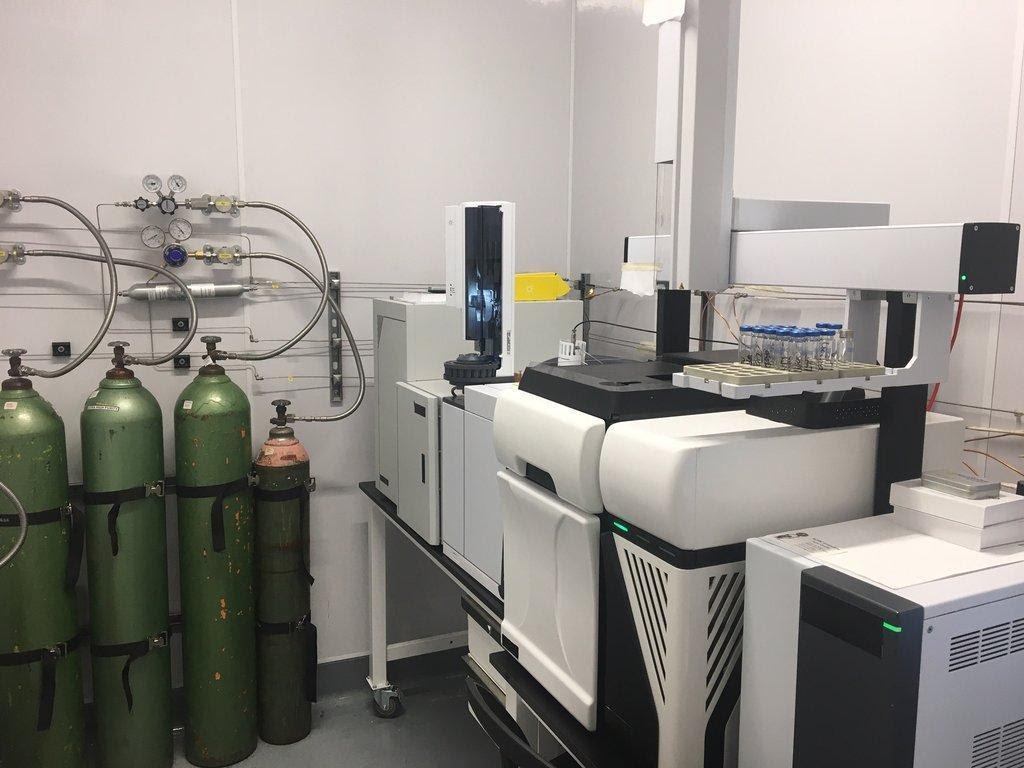
Testing Cannabis Green Flower
Abstrax Tech Instrument room housing 2-dimensional gas chromatographic system for cannabis green flower media testing.

Typically, cannabis industry labs use gas chromatography programs that read for 6, 12, 24, or 42 common cannabis terpene types, which is generally at the discretion or technical capabilities of the lab. What separates the Abstrax lab from other traditional cannabis labs is the number of terpenes they can detect.

Abstrax invested millions of dollars and years of research to build a custom terpene supercomputer that can read and break down the hundreds of terpenes cannabis has – and more, what they mean.

The Abstrax terpene test doesn’t just notice hundreds of other terpenes all other labs miss; they can see the terpenes from a bird’s eye view, whereas most other cannabis labs only have a one-dimensional plane of analysis.

Abstrax’s process is a 2-dimensional gas chromatographic system coupled with mass spectrometry designed to create a 3D Metabolite Fingerprint™. Compared with traditional 1-dimensional gas chromatography – a method commonly used in analytical labs – 2-dimensional gas chromatography (2DGC) allows for much better separation of compounds, a requirement to correctly identify and quantify them.

In short, the operating principle in 2DGC is to first separate compounds by molecular size, followed by the separation of these compounds further by polarity. This allows for much easier and more accurate identification of each compound compared with a simple 1-dimensional chromatogram.


2D & 3D Cannabis Green Flower Chromatogram

Green Flower Media Chromatogram
Left: Chromatogram obtained from traditional 1-dimensional gas chromatography of green flower cannabis. Right: Chromatogram obtained from 2-dimensional gas chromatography.

Abstrax can then analyze the 2D data in 3D to determine how much of each compound exists and the size of a peak corresponds to the quantity of a given compound.

Each spot represents an individual compound. Over 400 terpene compounds have been found in some green flower cannabis strains such as Jack Herer and Gelato. With this new powerful analytical technique, Abstrax has discovered numerous important compounds in cannabis that have never been reported before.

However, the most exciting aspect of this research has been the direct correlation between certain terpenes within cannabis and the effects (stimulating or sedative) they produce. Abstrax developed a metric they call “Strain Balance” to explain how the major components of a strain relate to one another.

This allows for understanding how complex a given strain’s aroma may present itself and what lies behind it. The aroma of cannabis is not only pungent but extremely complex and difficult to describe. Abstrax finds that in general, strains with a small number of compounds accounting for a high percentage of the total aroma concentration lead to less complex, more targeted aromas.

Conversely, strains that have more diversity in their highest concentration compounds often have more nuanced, complex aroma profiles. To approximate this, they introduce the Strain Balance Metric. This metric relates the top aroma compound concentrations to quantify how complex a strain profile is. This is calculated by conducting statistical analysis on the dominant terpenes and normalizing them from 0 – 100.

This terpene metric allows Abstrax to compare strains and dissect their aromas, which is new for cannabis science and technology. Each detected terpene has a researchable and determining effect type programmed in the Abstrax database.

When all the terpenes are calculated together, it gives a total effect type conclusion of that strain of cannabis. This means the cannabis industry doesn’t have to inaccurately guess the effect type based on strain names, Indica, or Sativa. Now, consumers select the effect they are looking for with their green flower cannabis.

Let us know what you think.

Do NOT Grow Another Plant Until You've Enrolled Into This! 💯
Cannabis Horticulture
A Carefully Curated Cultivation "Crash Course" On Everything You Need To Crank Out High-Yielding, "Cannabis-Cup Winner" Flowers That'll Generate HUGE Crops All-Year Long
Crafting Cannabis-Infused Edibles Takes MORE Than Ingredients... 🍽️
Edible Cannabis Products (100% FREE Training)
Enthusiasts Face Challenges Navigating An Ever-Expanding Array Of Cannabis Products & Delivery Methods From "Raw Flower" Smoothies To Infused-Edibles, Cannabinoid-Based Drinks + MORE.