


 Firing someone is never easy… firing someone you like, and who is trying hard is one of the most difficult things you will ever do as a leader in the cannabis industry.
And while we can’t remove all the emotion and all the pain from the process, we can make it a little easier and much, much fairer. Introducing, our “Cannabis Industry Performance Improvement Flowchart” we’re created…
It happens to every leader… someone on the team misses four (4) deadlines in a row. Or maybe they’ve lost three (3) of your best clients. Or maybe they keep getting poor reviews from customers… whatever the specific case may be in your cannabis business, we’ve all had that thought:
“Crap… am I going to have to fire someone?”
The idea of having to sit in a room and tell someone they’re being let go always leaves you with a sinking feeling in your chest. It’s uncomfortable – especially if the person is nice and trying hard. Luckily, there’s one important lesson when it comes to managing employees who can’t seem to get their work done. Most of the time, firing them isn’t the best way to solve the problem!
After all, hiring a replacement in the cannabis industry isn’t easy. Company culture is incredibly important, and when you have an employee who is the right culture fit, you should try like hell to keep them around. So, how do you go about firing someone fairly and respectfully? It’s simple…don’t fire anyone until after you have a “Cannabis Industry Performance Improvement Plan” in place.
Side Note: Our statement above does NOT apply in instances of gross misconduct, such as being in non-compliance, breaking the cannabis industry laws, harassment, theft, blatant discrimination, etc. We’ve put together a “Cannabis Industry Performance Improvement Flowchart” that ensures everyone is treated fairly, and everyone gets the opportunity to learn and (hopefully) grow.
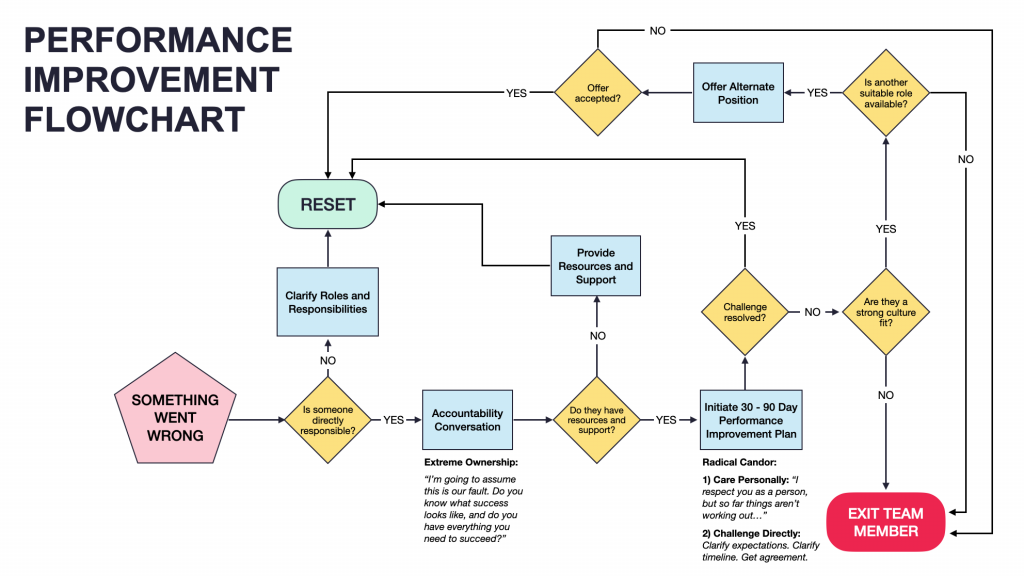
Something Went Wrong
 Let’s dive in and break it down together… this is where it all begins… someone didn’t do what they should have done, or someone didn’t do what they should have done as well as they should have done it. Either way, something went wrong, and your cannabis business and/or the customers have had to pay the price for someone else’s shortfall.
Just to reiterate, this process I’m about to subscribe to is NOT a fit for every scenario., in cases of gross misconduct (stealing cannabis, sexual harassment, threatening violence, etc.), immediate dismissal is not only justified, but it may also even be a requirement.
But what if someone just screwed up? Then what do you do? In this case, we look at this process, and start by asking the first question… “is someone directly responsible?” Anytime something breaks or a problem occurs… The first thought that will likely pop into your mind is, “Wait, wasn’t __________ supposed to do/fix that?” But what if that person didn’t realize it was a part of their job duties?
- Maybe it wasn’t on their job description nor receive any cannabis industry training.
- Maybe an email asking them to do it was left in draft mode (everyone has done that).
- Maybe the person who used to do it left the company, and that task was never reassigned?
Regardless of the reason, when something is missed in the cannabis industry, it’s best to assume that a lack of clarity was to blame, and not any one person. If that’s the case (and more times than, if you have a solid team, it will be), then the person to blame is YOU… the cannabis business leader.
As a leader, it’s your responsibility to clearly outline what your employees are uniquely responsible for. And if that doesn’t happen, it’s your job to fix it. So, what do you do if that person isn’t directly responsible? You CLARIFY! Have a conversation so that your teammate can get on the same page.
Update their job description if need be, and make sure they know what your expectations are moving forward in the cannabis business. Here’s a tip: Give your employees #7excludeGlossary so they have a clear, specific list that tells them what they are uniquely responsible for.
This can be a huge help when it comes to clarifying who is in charge of X, Y, and Z. Once you do that, it’s time for a reset. Remember, the problem was not with them, so we shouldn’t hold them at fault. That means, no calling them to the principal’s office and putting it on their permanent employee record.
But what if they were directly responsible, and they knew it?

Practice Extreme Ownership
 If someone isn’t doing their job in your cannabis business, a conversation about accountability is definitely in order. And it can be tempting to go in guns blazing and give them a piece of your mind, but we encourage you to take a DIFFERENT approach and practice Extreme Ownership.
This practice comes from the bestselling book “Extreme Ownership,” which talks all about great leadership (a great read, and required reading for all cannabis business leaders). In essence, extreme ownership says that if anything goes wrong, it’s the leader’s fault – because at the end of the day you either didn’t set that employee up for success or you made a bad hire in the constantly changing cannabis industry.
That’s tough to hear, I know. But when you’re walking into a meeting with an employee who’s struggling, pointing fingers and making them feel inept won’t make the problem better. If anything, it will just piss off your employee, and make you look like a real jerk at your cannabis business…
But with the mindset of extreme ownership, that conversation goes from an interrogation to a collaboration. Let’s look at two (2) approaches you could use so you’ll see what we mean:
1. Lead With Blame: “Listen, I don’t know where your heads at, but you dropped the ball on that one. Why can’t you do your job in our cannabis business?”
Sounds like a real jerk, right? Now compare that with this:
2. Lead With Empathy: “Hey so I know this problem happened, and I’m gonna assume that it’s our fault. I know you care, so if a ball got dropped, I’m guessing it’s either because we didn’t clearly explain our expectations, or we didn’t set you up to succeed. So, can you talk to me a little more about what happened so we can make sure something like this doesn’t happen again?”
Now we don’t know about you, but you’d much rather talk to that guy! Oftentimes, conversations that start with the latter will follow with… #11excludeGlossary And that’s a “good problem” in your cannabis business!
The value of having an “Accountability Conversation” is that it provides an opportunity for you to see where your employee may have room for growth. Not only that, but it will also expose possible cracks in your management style. It lets you find out where you have failed to set them up for success.
For example…
- You may find out that managers are assigning tasks that were not in their job description.
- Or you may find that this employee has too many tasks, and you need to re-prioritize.
- Or maybe they just don’t have the skills needed to effectively do their job.
In any case, “Accountability Conversations” help you answer this next essential question: “Do they have the resources and support they need to succeed in your cannabis business?”
Looking back at the flowchart, once you have had an “Accountability Conversation,” your first job is to assess whether or not you have given your employee everything they truly need to succeed in the cannabis industry. And if you determine that, no, they don’t have the necessary tools or environment to succeed, then your next task is simple… …give them what they freakin’ need!
Provide them with all the tools and resources and support they need to effectively do their job, and if you can’t do that, then alter your expectations of their performance. It’s the only fair thing to do. And once the resources have been provided in your cannabis business, follow up with the employee both “in-person” (phone call or Zoom meeting is fine) and in writing via email just confirm that:
- They do have everything they need, and…
- They acknowledge that they have what they need, and the problem, in question, won’t happen again.
That second part is important. You need to make sure you have buy-in from your employee that what you are giving them will guarantee success. This also ensures that there isn’t some deeper issue going on that’s causing the problem. Even if you don’t fully buy into their excuse, you must give them the benefit of the doubt and an opportunity to fix the issue.
If the issue is fixed, it’s time for another reset. But, what if the same issue comes back up, or what if you do determine that they have the resources and support they need to do the job? Then it’s time for a “Cannabis Industry Performance Improvement Plan” to be used in your cannabis business…
Cannabis Industry Performance Improvement Plan
 We won’t sugar-coat it… this part isn’t fun in the cannabis industry. Depending on the role, this plan can take anywhere from 30 – 90 days. More senior employees with complex roles will typically need more time to improve, whereas less senior team members can often show improvement in a shorter period (4 – 6 weeks).
The key is to match the duration of the “Cannabis Industry Performance Improvement Plan” to the amount of time needed for the employee to make some real changes, and for that change to yield real results in your cannabis business.
For example, a customer care rep who is missing his targets on #23excludeGlossary should be able to show improvement in a matter of weeks… maybe even days. So, for this example, a 30-day plan should allow more than enough time to show real performance change.
On the other hand, a senior-level executive struggling with hitting critical deadlines may need a full quarter to show that they’re getting their act together. Either way, in almost every case, the period should be no shorter than 30 days, and no longer than 90 days when you set these deadlines.
Throughout the “Cannabis Industry Performance Improvement Plan,” leaders practice “Radical Candor.” This is another amazing book on leadership that all leaders should read. “Radical Candor” comes down to giving feedback while caring personally and challenging directly.
This looks something like this:
“Hey __________, I like you, and I respect you as a person, but things aren’t working out right now. So, we need to take action to fix it, and here’s what that looks like…”
Next, do these three (3) important things:
1. Set Clear Improvement Expectations
“I need you to show up to work on time. We can’t work collaboratively and efficiently as a team in our cannabis business if you are walking into the morning meeting 10 minutes late every day.”
2. Set Clear Review Timeline
“So I need you to work on this over the next 2 months, and if you find halfway through that you just can’t seem to get here on time for whatever reason, please come talk to me about it, because we may have some other options we can talk about. But if I find that you’ve just given up halfway through, and you haven’t come to talk to me about why I’m going to have to let you go.”
3. Get Buy-In
“I want to make this work, cause I like having you here, and I know the team loves having you as well, so I’m gonna be on you about getting here on time—not because I don’t like you, or because I’m picking on you, but because I want you to succeed. So, is this something you feel like you can do with my help and support in our cannabis business?”
By setting clear expectations and outlining what will happen if those expectations aren’t met, you are challenging directly. By mentioning how much you and the team like the employee and explaining that your check-ins come from a place of genuine support and encouragement, you are caring deeply.
And as long as you are doing both honestly, you’re practicing Radical Candor, and your employee will know that you’re serious, but also that you want them to succeed. So, what happens if the timeline runs out and you can see that the challenge is resolved for them in your cannabis business?
Reset. And this is the key… it MUST be a true reset.
Going on a performance plan is not a smudge on your record. It’s an opportunity to grow and learn. Some of the most tenured leaders have been put on plans, and everyone was better for it. So, when someone succeeds, your response should be to celebrate and fully welcome them back into the fold.
Grudge-holding is not allowed. But, what happens if they don’t succeed? What if they give up, or can’t seem to make it work? What if the problem comes up again in the future? Ask yourself this:
“Is this person a strong culture fit?”
Does this person fit in well with the company? Do they uphold your company values and beliefs? Are they adding to the environment in a positive light in your cannabis business? If the answer is NO, then it’s time to let that person go. And this should be fairly smooth since you already set the expectation that they would be going if they did not resolve the issue. If the answer is YES, then what?
“Is there another suitable role available?”
Maybe customer support wasn’t the right place for them, but if there’s an opening on the cannabis dispensary team, and you think they have the skills needed for the dispensary technician role, invite them to apply, or consider an immediate transfer (if you’re feeling particularly confident).
If they take it, then, yet again… offer a reset… this option should also apply to people who come to you and tell you that they can’t work out the problem! After all, they were honest and up-front with you that they can’t meet the expectations for that role in your cannabis business.
If, however, you don’t have an opening for that person, you, unfortunately, have to let them go. This is the hardest thing in the world to do. It sucks! Firing good people who are trying their best and who are a good culture fit is one of the worst parts about being a leader, but you have to do it.
You owe it to that person to let them go and hopefully move into a position at another company where they can thrive. And if you know of another cannabis business or position outside your team where you think they would thrive, do what you can to aid them in that endeavor!
Effectively managing a team in the cannabis industry means taking accountability when things go wrong, doing everything you can to honestly and kindly support people who are growing and learning, and respecting that person enough to not let them linger in a job if they can’t succeed.
That’s what the “Cannabis Industry Performance Improvement Chart” is all about, and we hope it makes a difficult aspect of leadership just a little less painful for you in your cannabis business.
Let us know what you think.